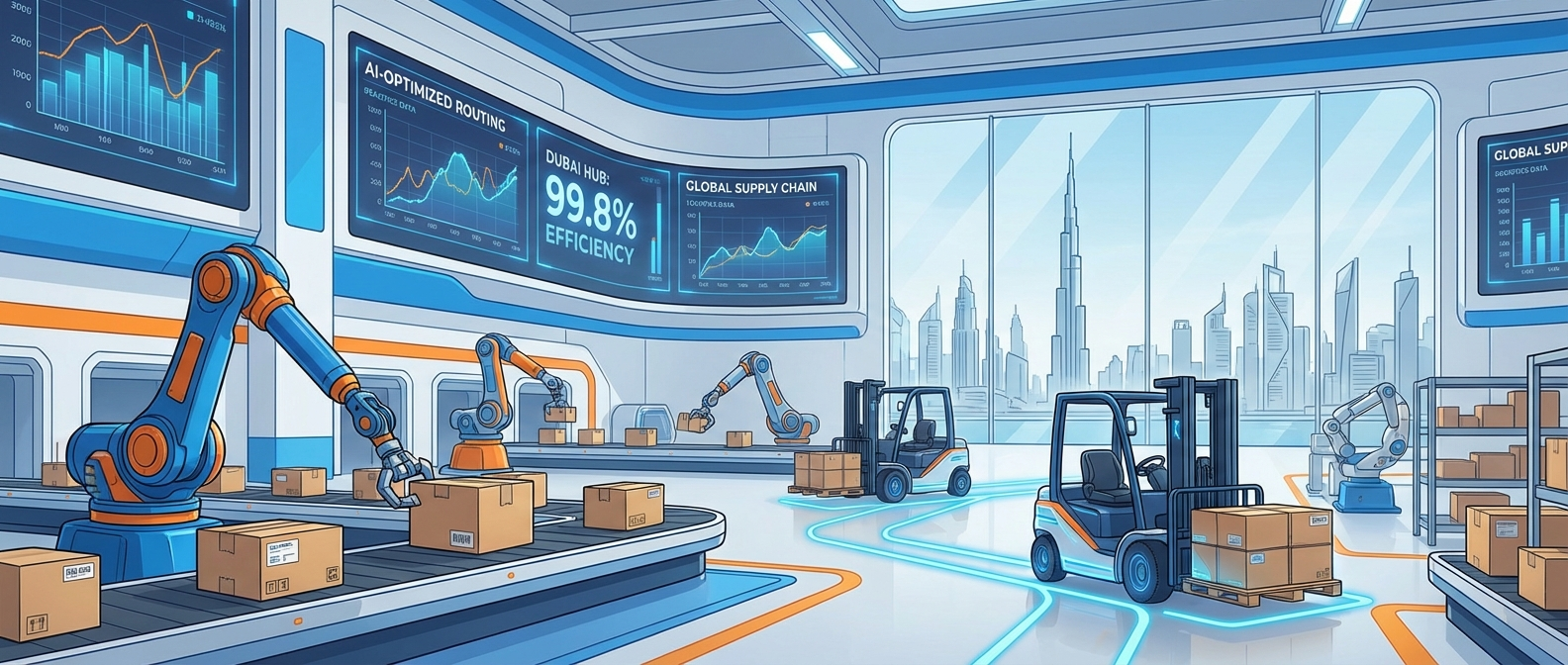
How Does AI Automation Transform UAE Logistics and Supply Chain Operations in 2026?
Quick Answer
AI automation is revolutionizing UAE logistics by reducing operational costs by 25-40%, improving delivery accuracy to 99.9%, and optimizing inventory management with predictive analytics. The UAE logistics automation market is projected to reach AED 4.36 billion by 2033, growing at 16.9% annually, making supply chain AI automation essential for competitive advantage in Dubai's fast-moving trade hub.
Table of Contents
- How AI Automation Transforms Supply Chain Efficiency
- Cost Savings and ROI in UAE Logistics Automation
- Route Optimization and Fleet Management
- Warehouse Automation and Inventory Management
- Predictive Logistics and Demand Forecasting
- Real-World UAE Companies Using Supply Chain AI
- Challenges and Implementation Barriers
- Frequently Asked Questions
- About Sinasoft
- Next Steps
How AI Automation Transforms Supply Chain Efficiency
Supply chain automation has shifted from optional innovation to operational necessity across Dubai's logistics sector. In 2026, artificial intelligence and machine learning are fundamentally reshaping how UAE companies manage inventory, optimize routes, and coordinate warehouse operations.
The transformation affects three core areas: supply chain visibility, automated decision-making, and real-time operational control. Companies implementing logistics AI automation report immediate improvements in throughput, accuracy and cost structure. According to recent industry research, global logistics automation reduces operational costs by 25-40%, with some specialized applications achieving 99.9% accuracy in picking operations.
UAE logistics leaders are recognizing that legacy systems can no longer support modern trade volumes. The emirate handles over 14 million tons of freight annually, and facilities embracing full warehouse automation have slashed operating costs by roughly 29% while maintaining near-perfect accuracy rates. For Dubai-based companies competing in global trade corridors, supply chain AI automation isn't competitive advantage—it's a baseline requirement.
AI supply chain solutions now include autonomous guided vehicles (AGVs), robotic picking systems, automated storage and retrieval systems (ASRS), and intelligent routing algorithms. These technologies work together to create what industry experts call "dark warehouses"—highly efficient facilities where machines operate with minimal human intervention, guided by infrared sensors, machine vision, and AI decision engines.
Cost Savings and ROI in UAE Logistics Automation
Financial justification is straightforward. Logistics automation delivers measurable ROI within 18-24 months for most UAE enterprises. Here's what the numbers show:
Warehouse Operations:
- Robotic picking systems boost order fulfillment speed by 3x compared to manual operations
- ASRS systems achieve 90% space utilization versus 50% in traditional warehouses
- Predictive analytics improves on-time delivery rates from 85% to 98%
- Cloud-based warehouse management systems improve inventory accuracy to 99.5%
Fleet and Route Optimization:
- AI route optimization cuts fuel costs by 15-20% in freight logistics operations
- IoT-enabled tracking reduces cargo loss by 35% across supply chains
- Automated compliance and documentation reduces processing time by 80%
- Real-time visibility systems reduce delays and exception handling by 40%
Labor and Operations:
- Automation reduces operational costs by 25-40% on average
- Predictive maintenance prevents costly equipment failures and downtime
- Labor cost reductions through automation typically reach 30-40% within year one
- Machine vision inspection achieves 99.9% accuracy, eliminating manual quality checks
For a mid-sized UAE logistics company handling 100,000 units monthly, implementing supply chain AI automation typically costs AED 2.5-4.8 million for a complete implementation, with annual savings ranging from AED 1.2-2.1 million. This delivers payback in 18-24 months, with benefits compounding in subsequent years.
Route Optimization and Fleet Management
Route optimization powered by machine learning is transforming how Dubai logistics companies deploy vehicles and manage fleets. Rather than relying on static routing rules or dispatcher experience, AI-driven systems analyze hundreds of variables in real-time: traffic patterns, weather, delivery time windows, vehicle capacity, fuel costs, and driver preferences.
Intelligent routing delivers:
- 15-20% reduction in fuel consumption per route
- 12-18% improvement in deliveries per vehicle per day
- Real-time dynamic re-routing based on traffic and emergencies
- Predictive arrival time accuracy within 2-3 minutes
- Automated compliance with UAE driving regulations and rest requirements
Companies using predictive logistics algorithms report 10-15% fewer failed delivery attempts, reducing costly return trips. For final-mile delivery in Dubai and Abu Dhabi, this directly translates to faster customer service and lower handling costs.
Autonomous fleet management systems also enable better asset utilization. Instead of maintaining fleets for peak periods with many idle vehicles during quiet times, predictive models forecast demand and optimize fleet size and composition.
Warehouse Automation and Inventory Management
Modern warehouse automation represents the largest single efficiency gain in supply chain AI automation. In 2026, leading UAE logistics facilities are transitioning from labor-intensive manual picking and sorting to fully automated environments controlled by intelligent systems.
Warehouse automation technologies include:
Automated Storage and Retrieval (ASRS): These systems stack inventory vertically, dramatically increasing space efficiency. A 10,000 square meter facility with ASRS systems can handle the same volume as a 20,000 square meter facility with traditional shelving—while consuming 33% less energy and operating 24/7 without fatigue.
Robotic Process Automation (RPA): Handles repetitive tasks like invoice processing, order entry, and customs documentation. Machine learning systems learn from examples and improve accuracy over time, reducing manual data entry errors by 55-80%.
Intelligent Inventory Management: Predictive analytics forecasts demand, optimizes stock levels, and identifies slow-moving inventory before it becomes costly excess. AI systems reduce stockouts by 50% while cutting excess inventory holding costs.
Vision-Based Quality Inspection: Machine vision systems inspect every package for damage, proper labeling, and contents verification at warehouse throughput speeds (6,000+ items per hour). Defect detection accuracy reaches 99.9%.
Predictive Logistics and Demand Forecasting
Demand forecasting powered by machine learning is becoming the competitive differentiator for UAE supply chain leaders. Traditional forecasting based on historical averages frequently misses seasonal patterns, market shifts, and supply disruptions. AI forecasting systems analyze much richer datasets: social media trends, weather patterns, competitor activity, economic indicators, and import/export data.
Predictive analytics delivers:
- 25-35% reduction in forecast error compared to traditional methods
- 50% reduction in stockouts and demand spikes causing lost sales
- 40% reduction in excess inventory and carrying costs
- Better allocation of warehouse capacity between product categories
- Automated recommendations for replenishment timing and quantities
For Dubai logistics companies supporting regional trade, predictive forecasting enables proactive inventory positioning. Instead of reacting to demand after it appears, AI systems position stock before demand manifests, ensuring availability while minimizing excess inventory.
Real-World UAE Companies Using Supply Chain AI Automation
Dubai Traders Initiative with IQ Fulfillment (February 2026): The Dubai Department of Economy and Tourism partnered with IQ Fulfillment to provide AI-powered logistics to over 3,400 SMEs on platforms like Noon and Amazon. The program offers robotics-driven warehouses, AI-enabled warehouse management systems, and advanced analytics tools. Participating SMEs receive up to 20% discounts on fulfillment services, free inbound handling for the first 1,000 units, and one-year complimentary subscriptions to IQ Plus analytics platform. IQ Fulfillment reports 99% accuracy in order fulfillment.
Jebel Ali Free Zone Modernization: Dubai's largest free zone has implemented "dark warehouse" facilities featuring AI-powered inventory management, autonomous material handling, and real-time tracking. These facilities consume 33% less energy than conventional warehouses while operating around the clock with minimal staffing.
Logistics Sector Investment Trends: Foreign capital specifically targeting automation-ready facilities reached approximately AED 17.3 billion in early 2025. Automation-equipped warehouses command 15-25% price premiums over traditional facilities and attract blue-chip corporate tenants.
Challenges and Implementation Barriers
Despite clear benefits, UAE companies face obstacles implementing supply chain AI automation:
Technical Challenges:
- Integration with legacy systems still running in many older facilities
- Data quality issues when systems were designed without integration in mind
- Cybersecurity requirements for connected IoT and warehouse systems
- Skilled workforce scarcity for AI operations and maintenance
Organizational Challenges:
- Change management resistance from workforce accustomed to traditional processes
- Upfront capital investment required (AED 2.5-4.8 million typical for mid-sized operations)
- Training requirements for supervisors to manage AI-driven operations
- Lack of standardized metrics for measuring automation ROI
Companies addressing these barriers typically follow a phased implementation approach: starting with warehouse automation, then expanding to fleet management, and finally integrating demand forecasting systems.
Frequently Asked Questions
What is supply chain AI automation?
Supply chain AI automation applies artificial intelligence, machine learning, and robotics to logistics operations. It includes warehouse automation, route optimization, demand forecasting, and real-time inventory management. The goal is to reduce costs, improve accuracy, and enable 24/7 operations with minimal human intervention.
How much does supply chain automation cost for UAE companies?
Implementation costs vary based on facility size and automation scope. Small facilities (5,000-10,000 m²) typically invest AED 1.2-2.5 million. Mid-sized operations (20,000-50,000 m²) invest AED 2.5-4.8 million. Most companies see payback within 18-24 months.
How quickly can we see results from logistics automation?
Benefits appear immediately: accuracy improvements and speed gains within days of going live. Cost reduction typically manifests within 4-8 weeks as systems optimize operations. Full ROI realization usually requires 18-24 months.
Can AI automation work in Dubai's multi-modal transportation environment?
Yes, and it's particularly valuable. AI systems excel at coordinating across multiple transportation modes: maritime, air, road, and rail. Unified visibility systems optimize handoff timing and reduce delays at transfer points.
What skills do we need to operate AI-powered logistics?
Required roles shift from manual materials handlers to system operators, data analysts, and maintenance technicians. Training typically requires 4-8 weeks for basic operations and 2-3 months for advanced roles.
How does AI improve customer service in logistics?
Better accuracy (99.5-99.9%) means fewer delivery failures. Real-time tracking provides customers with precise 1-2 hour delivery windows. Automated exception detection keeps customers informed immediately when issues arise.
Is AI automation suitable for small and medium-sized companies?
Yes. The Dubai Traders initiative demonstrates how smaller companies can access automation through shared facilities and managed services. Costs have decreased 20-30% over the past two years.
How does supply chain automation affect employment in UAE?
Labor impacts vary. Total headcount often decreases 15-25%, but job quality typically improves. Manual materials handling roles decline, while skilled technical roles grow. Many UAE companies find natural attrition absorbs changes without layoffs.
What's the relationship between AI automation and delivery speed?
AI-optimized operations reduce fulfillment time from 24-48 hours to 8-16 hours. Route optimization reduces transit time 10-15%. Automated picking at 3x manual speed contributes additional time savings. Combined impact: 2-3 day faster delivery.
How do we ensure AI systems comply with UAE regulations?
Automation systems must respect labor laws, customs regulations, and data sovereignty requirements. Most enterprise automation solutions include compliance modules. Companies typically work with logistics consultants to ensure regulatory alignment regarding customs documentation and data residency.
Real-World Examples
Case Study 1: Dubai SME Scaling to Regional Distribution A Dubai-based e-commerce company moved from manual warehouse operations handling 50,000 units monthly to automated facility managing 150,000 units. Implementation: AED 3.2 million. Results after 18 months: costs reduced by 32%, accuracy improved to 99.7%, delivery times shortened by 2.5 days. Annual savings: AED 1.4 million.
Case Study 2: Enterprise Fleet Optimization A UAE logistics company with 200-vehicle fleet implemented predictive route optimization. Investment: AED 2.8 million. Results: fuel costs reduced 18%, deliveries per vehicle increased from 8.2 to 9.8, complaints down 41%. Annual savings: AED 2.1 million.
About Sinasoft
Sinasoft is a Dubai-based AI automation consultancy specializing in custom AI solutions for UAE businesses. We help companies implement compliant, Arabic-enabled automation that saves time and increases ROI. Our expertise spans logistics automation, supply chain optimization, warehouse management systems, and predictive analytics.
Next Steps
Ready to transform your logistics with AI automation? Contact Sinasoft:
Email: [email protected]
Published: March 3, 2026