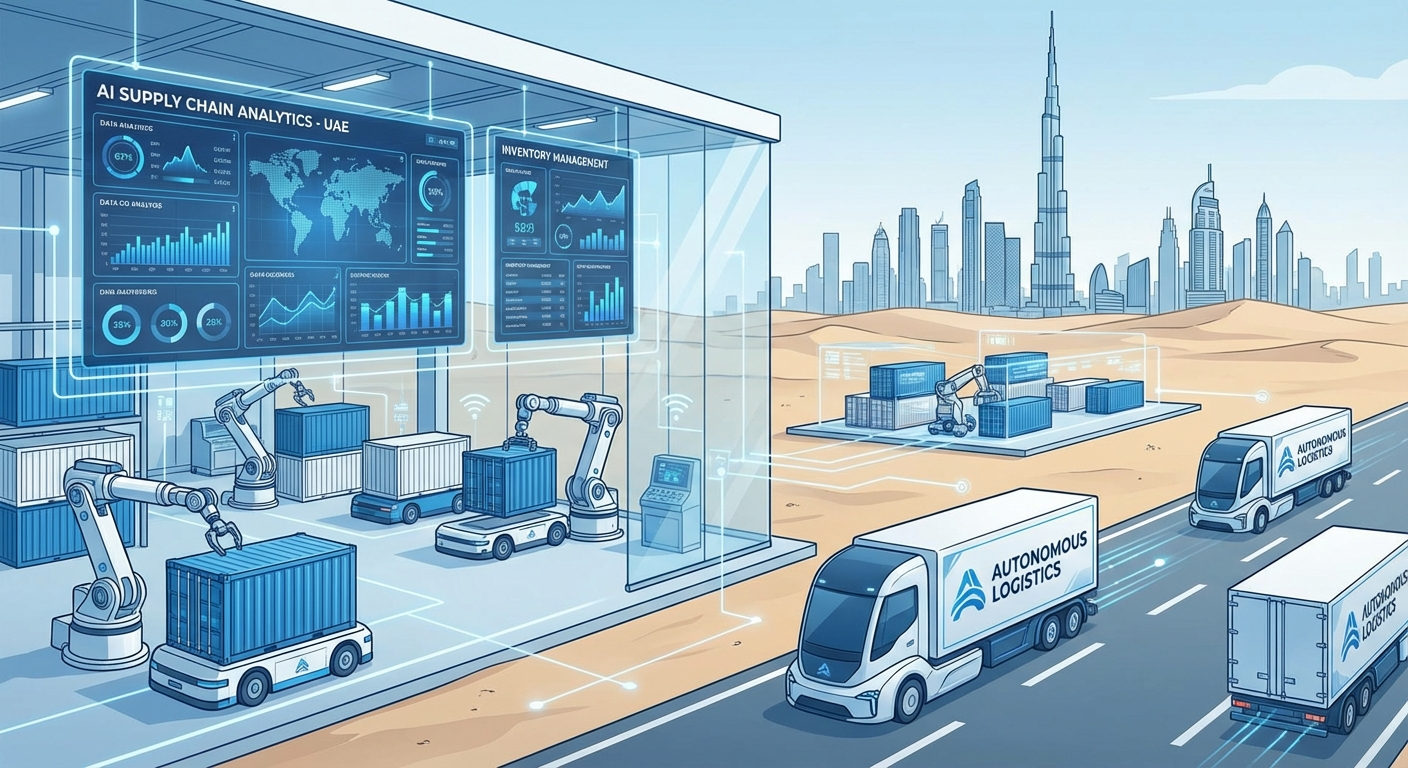
How Can UAE Logistics Companies Automate Supply Chain Operations with AI in 2026?
Quick Answer
AI supply chain automation is transforming UAE logistics at scale. In 2026, warehouse automation Dubai companies are saving 40+ hours per employee monthly through inventory management AI and predictive logistics UAE systems. Initial setup typically costs AED 8,000–35,000 (depending on operation size), with monthly operational costs of AED 2,500–12,000. ROI is achieved within 4–6 months for most mid-sized logistics operations.
Table of Contents
- Why UAE Logistics Companies Are Adopting AI Automation in 2026
- AI Supply Chain Automation: Core Applications
- Warehouse Automation Dubai: Real-Time Visibility
- Inventory Management AI: Predictive & Responsive
- Predictive Logistics UAE: Demand Forecasting
- Implementation & Cost Breakdown
- Real-World UAE Examples
- Frequently Asked Questions
- About Sinasoft
- Next Steps
Why UAE Logistics Companies Are Adopting AI Automation in 2026
The UAE is the world's third-largest logistics hub, with Jebel Ali Port in Dubai handling over 15 million TEU annually and billions of dollars in trade flowing through Abu Dhabi's KEZAD industrial zone. Yet demand forecasting, route optimization, and inventory management remain manually intensive—costly and prone to error.
AI supply chain automation is closing that gap. According to Grand View Research (2026), the UAE logistics automation market is projected to grow from USD 349.4 million in 2025 to USD 1,186.8 million by 2033, at a CAGR of 16.9%. The fastest-growing segment? Services—indicating that UAE businesses are not just buying hardware, but building sustainable automation ecosystems.
This growth reflects a strategic shift: AI is now core to logistics decision-making. Modern platforms leverage machine learning to automate routing decisions, demand forecasting, warehouse operations, and fleet utilization. Unlike legacy systems, AI-powered logistics software continuously learns from real-time data, enabling faster responses to disruptions, improved delivery accuracy, and reduced operating costs.
In February 2026, Abu Dhabi launched the region's first autonomous freight truck pilot in KEZAD industrial zone—a milestone signaling regulatory confidence and real-world readiness for AI-driven transport automation.
AI Supply Chain Automation: Core Applications
Demand Forecasting & Inventory Optimization
Predictive logistics UAE systems analyze historical demand patterns, seasonal trends, and market signals to forecast inventory needs weeks or months ahead. This eliminates overstocking (tying up capital and warehouse space) and stockouts (losing sales and customer trust).
A typical implementation:
- AI model ingests supplier lead times, customer orders, and external market data
- System predicts required stock levels by product category, warehouse location, and time period
- Automated alerts trigger reorder when inventory falls below optimal thresholds
- Result: 30–40% reduction in excess inventory, 15–25% fewer stockouts
Route Optimization & Last-Mile Delivery
With Dubai and Abu Dhabi's traffic congestion growing, route efficiency directly impacts margins. AI supply chain automation platforms use real-time GPS, traffic data, and historical delivery times to generate optimal routes for each driver, reducing fuel costs by 15–20% and delivery times by 10–15%.
Warehouse Automation Dubai: Robotic & Intelligent
Warehouse automation Dubai deployments now combine physical robots (picking, sorting, conveyor systems) with AI-driven inventory management. Robots handle high-frequency, predictable tasks; AI systems dynamically allocate tasks and optimize storage layout.
Key results:
- Labor efficiency: 40–50 hours saved per employee monthly
- Throughput: 2–3× faster order fulfillment
- Accuracy: Near-zero picking errors vs. 2–5% manual error rates
Warehouse Automation Dubai: Real-Time Visibility
Modern warehouse automation systems integrate IoT sensors, cloud dashboards, and centralized control towers for real-time tracking of inventory, shipments, and equipment. Managers can monitor warehouse operations from mobile devices, and AI systems surface bottlenecks automatically.
Benefits for UAE logistics operations:
- Instant transparency across all supply chain nodes
- Predictive alerts for equipment failures before they disrupt operations
- Customer confidence: Ability to provide precise delivery windows, not estimates
- Compliance: Audit trails for regulatory requirements (FZCO, Jebel Ali, KEZAD zones)
Inventory Management AI: Predictive & Responsive
Inventory management AI goes beyond static rules. Modern systems use demand sensing (POS data, social signals, weather), supplier reliability metrics, and cost modeling to dynamically adjust stock levels in real time.
For UAE e-commerce and retail:
- Dynamic slotting: Fast-moving items positioned near dispatch areas
- Multi-location optimization: Distribute inventory across Dubai, Abu Dhabi, and regional hubs to minimize shipping distances
- Seasonal & event planning: Automatically adjust inventory for Ramadan, Summer sales, and major shopping events
Cost impact: AED 2,500–6,000/month for small–medium operations (sub-AED 100M annual inventory).
Predictive Logistics UAE: Demand Forecasting
Demand forecasting powered by machine learning accounts for factors that simple historical averages miss:
- Macroeconomic signals: Oil prices, exchange rates, GDP growth trends
- Seasonal & cyclical patterns: Summer peaks, winter troughs, holiday demand
- Market disruptions: Port delays, supplier strikes, weather events
- Customer behavior: Purchase velocity, product substitution patterns
A Dubai-based 3PL operator implementing predictive logistics UAE systems reduced forecast error from ±18% to ±6%, enabling tighter inventory planning and 22% lower carrying costs.
Implementation & Cost Breakdown
Small Operations (500–5,000 SKUs, 1–2 warehouses)
- Setup: AED 8,000–15,000 (software licensing, integration, training)
- Monthly: AED 2,500–5,000
- ROI timeline: 4–5 months
Medium Operations (5,000–50,000 SKUs, 3–5 warehouses)
- Setup: AED 18,000–32,000
- Monthly: AED 6,000–10,000
- ROI timeline: 5–6 months
Large Enterprise (50,000+ SKUs, regional hubs)
- Setup: AED 35,000–80,000+ (custom integration, robotics, advanced features)
- Monthly: AED 12,000–25,000+
- ROI timeline: 4–7 months (often faster due to scale)
ROI drivers:
- Labor savings: 40+ hours reclaimed per employee per month = AED 4,800–7,200 annually
- Inventory reduction: 20–30% lower carrying costs
- Delivery efficiency: 15% fuel savings, 10% faster throughput
- Error reduction: 3–5% fewer returns, rework, and customer service costs
Real-World UAE Examples
KEZAD Industrial Zone – Autonomous Freight Trial (February 2026)
Abu Dhabi Mobility launched the region's first autonomous freight truck pilot in KEZAD, the emirate's largest industrial zone. Supervised by Abu Dhabi Mobility and global autonomous systems firm Autotech, the trial tests how autonomous trucks perform in controlled industrial environments before wider rollout.
Implications for UAE logistics companies:
- Regulatory confidence in autonomous technologies
- Opportunity to reduce driver-dependent operational costs
- Path to 24/7 round-the-clock logistics operations
IQ Robotics – Dubai-Based Warehouse Automation
Founded in Dubai in 2018, IQ Robotics specializes in fully automated solutions powered by robotics and AI for supply chain and logistics. Their deployments across Dubai and Abu Dhabi demonstrate practical implementation of warehouse automation Dubai for mid-sized and enterprise logistics operators.
Key results from client deployments:
- Throughput: 2–3× improvement in order fulfillment speed
- Labor: Reclaimed 45+ hours per employee monthly for higher-value work
- Accuracy: Near-zero picking errors
Micropolis Robotics – Autonomous Logistics Platform (January 2026)
At UMEX 2026 in Abu Dhabi, Micropolis Robotics unveiled an autonomous logistics platform with:
- 12–18 hours operational range
- 4–5 tons payload capacity
- WMS integration (connects autonomous robots to warehouse management systems)
- Fleet management & real-time monitoring
The platform is designed for controlled industrial environments (manufacturing facilities, free zones, logistics corridors)—precisely where UAE supply chains concentrate.
Frequently Asked Questions
How much time does AI automation save UAE logistics companies?
UAE logistics companies typically save 40+ hours per month per employee through AI automation, equivalent to one full work week of productivity. This includes time saved on demand forecasting, inventory counts, exception handling, and route planning.
What is the ROI of AI supply chain automation in UAE?
For a typical UAE mid-sized logistics company, AI automation saves AED 3,500–5,500 per employee monthly in reclaimed productivity and operational efficiency. For a 10-person warehouse team, that's AED 35,000–55,000 in monthly savings, achieving ROI within 4–6 months.
Does predictive logistics work with Arabic data and bilingual operations?
Yes. Modern AI systems support Arabic (formal and regional dialects) for document processing, forecasting labels, and customer communication. Sinasoft's solutions are specifically tuned for bilingual (Arabic/English) UAE business environments, handling both local market nuances and international logistics workflows.
Can small UAE logistics startups afford AI supply chain automation?
Absolutely. Cloud-based inventory management AI platforms now start at AED 2,500–4,000/month for small operations. No expensive on-premise hardware required. Entry-level implementations focus on demand forecasting and inventory optimization before adding warehouse robotics.
How long does implementation typically take?
- Basic implementation (demand forecasting + inventory optimization): 2–4 weeks
- Warehouse integration: 6–8 weeks
- Full multi-location rollout: 3–6 months
Speed depends on data quality (historical orders, supplier info) and existing system integrations.
What happens if AI forecasts are wrong during disruptions (port strikes, supply shocks)?
Modern systems include human override. AI generates recommendations, but logistics managers retain full control. When disruptions occur, the system adapts by flagging exceptions immediately, recommending corrective actions, and learning from the event to improve future forecasts.
Is integrating AI with existing legacy WMS and ERP systems difficult?
Modern AI supply chain automation platforms are API-first, meaning they connect to existing systems (Oracle, SAP, custom-built WMS) without replacing them. Integration typically takes 3–4 weeks for standard systems.
How secure is cloud-based warehouse automation?
Enterprise-grade logistics AI platforms (SOC 2 Type II, ISO 27001 certified) meet UAE data residency requirements and international security standards. All data stays encrypted in transit and at rest.
About Sinasoft
Sinasoft is a Dubai-based AI automation consultancy specializing in custom AI solutions for UAE businesses. We help companies implement compliant, Arabic-enabled automation that saves time and increases ROI.
Whether your challenge is demand forecasting, warehouse optimization, or full supply chain visibility, our team designs, builds, and deploys AI-driven systems that integrate seamlessly with your existing operations. We focus on practical, measurable outcomes—not hype.
Next Steps
Ready to explore how AI supply chain automation can transform your logistics operations?
📧 Email: [email protected]
We'll assess your current workflows, discuss your most pressing supply chain challenges, and outline a clear path forward—including estimated costs and ROI for your operation.
No obligation. Just practical guidance from logistics AI experts who understand the UAE market.
Last updated: March 2, 2026
Data sources: Grand View Research (2026), Abu Dhabi Mobility (Feb 2026), Micropolis Robotics (Jan 2026), IQ Robotics (Case studies)