Quick Answer
Agentic AI should make decisions without human approval in the UAE only when the action is low risk, reversible, policy-bounded, and fully logged. In Dubai and Abu Dhabi, human approval should stay mandatory whenever an AI action affects money movement, legal rights, regulated data, hiring, healthcare, safety, or public outcomes. The best 2026 model for UAE businesses is bounded autonomy: let AI move routine work fast, but keep consequential decisions under accountable human control.
Table of Contents
- What Agentic AI Means for UAE Businesses in 2026
- The Four Approval Levels Dubai and UAE Companies Should Use
- When AI Can Act Without Human Approval in the UAE
- When Human Approval Must Stay Mandatory in Dubai
- The UAE Compliance Checks That Matter Before Autonomy
- A Practical Governance Framework for Agentic AI in Dubai
- What Agentic AI Governance Costs in AED for UAE Teams
- Frequently Asked Questions
- Real-World Examples
- About Sinasoft
- Next Steps
What Agentic AI Means for UAE Businesses in 2026
Agentic AI in the UAE means software that does more than answer prompts. It can classify requests, call tools, route cases, update systems, draft actions, and complete workflows across Dubai and Abu Dhabi operations. That makes approval design a business governance issue, not just a technical setting.
The timing matters. On 8 January 2026, Microsoft reported that the UAE ranked first globally in AI adoption, with 64.0% of the working-age population using AI by the end of 2025. If UAE teams are using AI at that scale, then every Dubai leadership team needs a clear answer to one question: what should AI do alone, and what should still require human approval?
For most UAE organizations, the wrong move is treating all automation as equal. A Dubai company can safely let AI route service tickets or extract invoice fields long before it should let AI approve a large refund, reject a job candidate, or trigger a compliance escalation. That is why agentic AI governance in Dubai has to start with decision rights, thresholds, and accountability.
If you are planning broader rollout, our guides on scaling AI agents from pilot to production and preventing AI agent budget overruns in Dubai are useful next reads.
The Four Approval Levels Dubai and UAE Companies Should Use
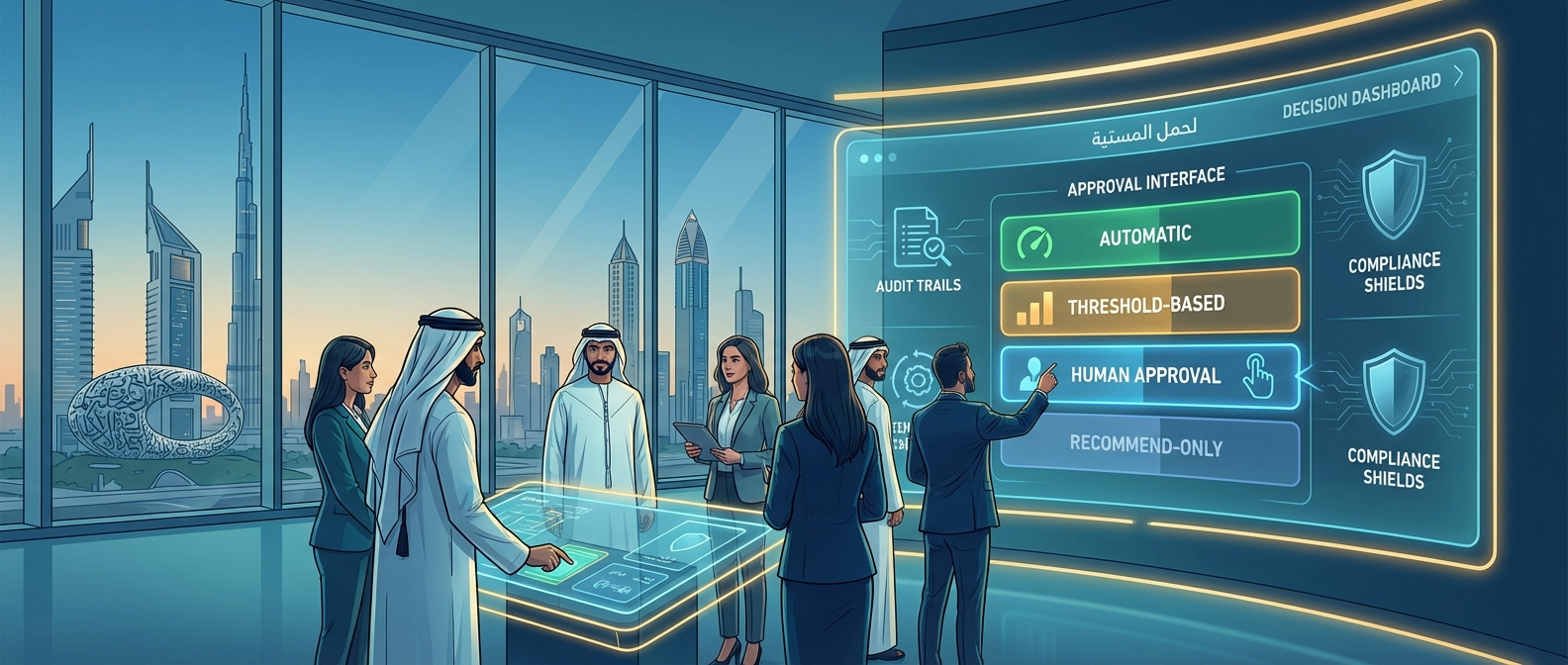
The cleanest operating model for agentic AI UAE deployments is a four-level approval ladder.
-
Execute automatically. Use this in Dubai for low-risk, reversible actions with clear rules, such as ticket routing, document tagging, internal scheduling, knowledge retrieval, or non-binding draft replies.
-
Execute automatically within thresholds. This works in the UAE when the action stays inside approved guardrails. Examples include routine stock replenishment below AED 5,000, service credits below AED 500, or low-value procurement routing with sampled review.
-
Human approval before execution. This should be the default for most meaningful Dubai workflows. The AI can recommend, prepare the action, and explain the reasoning, but a human approves before the system changes a customer record, payment, contract term, or employee file.
-
Recommend only. For high-risk UAE use cases, AI should stay advisory. That includes credit decisions, disciplinary actions, suspicious activity reporting, medical decisions, legal strategy, and any step that could materially affect rights, safety, or regulatory standing.
This model keeps human-in-the-loop AI practical. It also prevents the common Dubai mistake of pushing full autonomy into workflows that clearly need oversight.
When AI Can Act Without Human Approval in the UAE
In Dubai and the wider UAE, AI can act without human approval only when five conditions are true.
- The action is reversible. If a Dubai team can quickly undo the step without customer harm, autonomy is safer.
- The impact is low. Queue movement, triage, summarization, and internal routing are safer than decisions involving money, rights, or compliance.
- The policy is explicit. If the rule can be written clearly, AI compliance UAE is manageable. If the task depends on judgment or negotiation, human review belongs in the loop.
- The workflow is fully observable. Every prompt, tool call, output, and exception should be logged for UAE audit and root-cause review.
- The fallback path is tested. Dubai teams should be able to pause the agent, escalate the case, and recover the workflow without disruption.
Good AI automation Dubai examples include ticket triage, invoice extraction, document classification, maintenance scheduling, internal reporting, Arabic-English content drafting, and first-pass quality checks. These are strong starter workflows because they save time without handing sensitive judgment entirely to the machine.
When Human Approval Must Stay Mandatory in Dubai
Human approval should stay mandatory in Dubai whenever the AI action changes money, rights, regulatory exposure, or safety.
That includes refund approvals above a threshold, pricing exceptions, contract commitments, hiring or rejection decisions, KYC and AML escalations, healthcare workflow choices, security incident severity calls, and external legal statements. In the UAE, these are not just workflow steps. They are accountability decisions.
A simple Dubai test works well: if a manager, lawyer, finance controller, compliance officer, or clinician would need to defend the outcome later, the AI should not act alone.
For many UAE businesses, the safest pattern is AI drafts, human decides, AI executes. The AI does the heavy lifting, but a person owns the consequential step. That is usually the right target operating model for regulated Dubai sectors, including finance, healthcare, public services, education, and HR.
The UAE Compliance Checks That Matter Before Autonomy
Before any Dubai company grants autonomy to agentic AI UAE workflows, it should pass a simple compliance screen.
- Personal data check: Does the workflow touch customer, employee, biometric, health, or financial data?
- Jurisdiction check: Does the process sit under UAE mainland rules, DIFC, ADGM, or multiple entities across Dubai and Abu Dhabi?
- Outcome check: Could the AI output trigger a regulatory filing, customer entitlement, fraud flag, or disciplinary action?
- Explainability check: Can the team explain the AI decision in language a Dubai auditor, regulator, or executive can understand?
- Override check: Can a human stop, reverse, or correct the action fast?
For regulated environments, official local guidance matters. Dubai firms operating in DIFC should review the DIFC Commissioner of Data Protection, while Abu Dhabi teams in ADGM should align with the ADGM Office of Data Protection. These frameworks make one point very clear: AI autonomy in the UAE is acceptable only when governance, privacy, and accountability are designed in from the start.
A Practical Governance Framework for Agentic AI in Dubai
If a Dubai business wants reliable AI governance Dubai, it should put seven controls in place before expanding autonomy.
- Decision inventory: List every action the AI can take in UAE systems.
- Risk-tier matrix: Assign each action to approve automatically, approve within threshold, human approval, or recommend-only.
- Threshold policy: Define hard limits by AED value, customer impact, data sensitivity, and jurisdiction.
- Role-based execution: Separate what the agent may read, draft, recommend, or execute in Dubai systems.
- Audit trail: Log prompts, outputs, approvals, overrides, and exceptions for each UAE workflow.
- Kill switch and rollback: If the agent misfires in Dubai, someone must be able to pause it immediately and recover safely.
- Monthly governance review: Track false positives, false negatives, exception rates, and AED value created or put at risk.
This is also where Arabic support matters. If a Dubai or Abu Dhabi workflow runs in both English and Arabic, governance should test both language paths, not just the English version. A bilingual workflow with weak Arabic QA is still weak governance.
What Agentic AI Governance Costs in AED for UAE Teams
Many Dubai companies underestimate the cost of safe autonomy.
A low-risk internal pilot usually needs AED 35,000 to AED 90,000 for workflow design, prompt and policy engineering, integration, and baseline logging. A mid-risk UAE rollout with approval gates, dashboards, and bilingual QA often costs AED 90,000 to AED 250,000 to implement, plus monthly operating costs of AED 25,000 to AED 80,000. A higher-risk Dubai deployment in finance, healthcare, or public services can easily reach AED 250,000 to AED 700,000+, with ongoing governance and monitoring overhead.
That extra spend is not waste. In the UAE, one poorly governed autonomous decision can cost more than the entire control layer that would have prevented it.
Frequently Asked Questions
Can agentic AI approve customer refunds in Dubai without a manager?
Yes, but only for low-value refunds with explicit AED thresholds, full logging, and a clean reversal path. Anything outside the rule set should route to human approval in Dubai.
Should UAE banks let AI make final compliance decisions alone?
Usually no. AI can prioritize alerts, summarize evidence, and recommend next steps, but final regulatory or customer-impacting decisions in the UAE should stay under human control.
What is the best default approval model for Dubai companies?
For most Dubai teams, the best default is AI recommends, human approves, system executes. It captures most of the speed benefit without surrendering accountability.
Which UAE workflows are safest for no-approval AI actions first?
Start with routing, classification, extraction, scheduling, internal reporting, and knowledge retrieval. These give UAE businesses quick wins without putting sensitive judgment in machine hands.
Do DIFC and ADGM entities need stricter controls than many standard workflows?
Yes. If a Dubai or Abu Dhabi entity operates in a regulated environment, the approval policy, logging depth, and privacy review should be stricter from day one.
How often should Dubai leadership review AI autonomy rules?
At least monthly during rollout and after any major incident, model change, or workflow expansion. AI governance Dubai is an operating discipline, not a one-time policy document.
What is the biggest mistake UAE companies make with agentic AI?
They grant autonomy too early. In the UAE, the fastest path to value is controlled autonomy with clear thresholds, not unrestricted automation.
Real-World Examples
A strong public-sector example already exists in Dubai. In a February 2026 update, Digital Dubai and RTA described the AI-powered Madinati service, built with partners including DEWA and Dubai Municipality. The workflow analyzes images, identifies issues, and routes reports to the right entity faster, while accountable resolution remains with the responsible authority. The same update noted that the service had processed more than 285,281 reports and observations since launch.
That is the right pattern for UAE private-sector teams too. Let AI handle intake, triage, drafting, and routing in Dubai. Keep the consequential decision with accountable humans when the action affects money, rights, regulation, or safety.
About Sinasoft
Sinasoft is a Dubai-based AI automation consultancy specializing in custom AI solutions for UAE businesses. We help companies automate operations, reduce costs, and achieve measurable results through AI implementation tailored to your specific needs.
Next Steps
Ready to automate your business with AI? Contact Sinasoft to plan the right approval model for your UAE workflow.
📧 Email: [email protected]
🌐 Website: sinasoft.co