Quick Answer
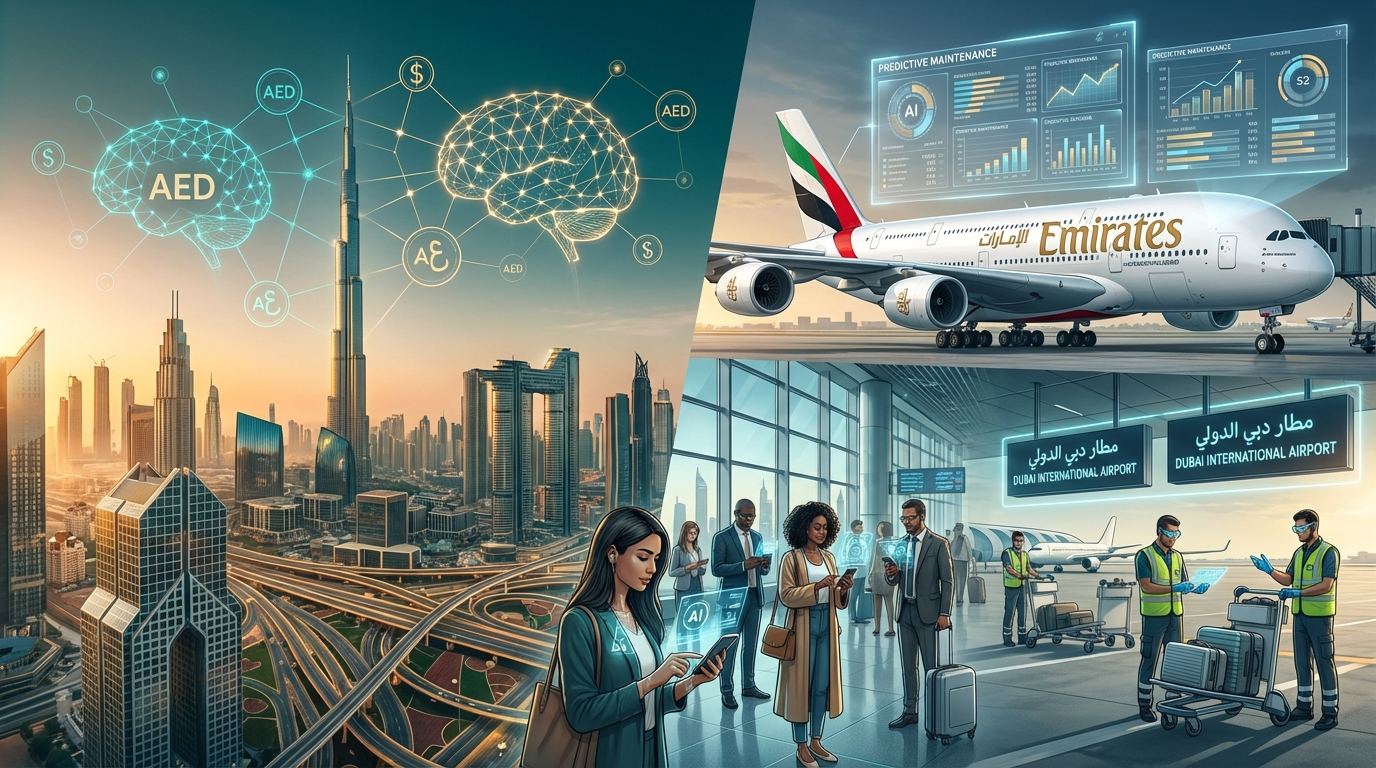
Dubai's aviation sector—led by Emirates and Etihad—is leveraging AI automation to streamline crew scheduling, reduce delays by up to 35%, and cut customer service costs by 40% in 2026. From intelligent flight routing at Dubai International Airport to predictive maintenance and personalized passenger experiences, AI automation is reshaping how airlines operate across the UAE and Abu Dhabi.
Table of Contents
- The Current State of AI in Dubai Aviation
- AI-Powered Crew Scheduling and Route Optimization
- Predictive Maintenance and Fleet Management
- Intelligent Passenger Experience and Personalization
- AI Chatbots and Customer Service Automation at Dubai Airports
- Baggage Handling and Ground Operations Automation
- Revenue Management and Dynamic Pricing
- Cost Savings and ROI for Dubai Aviation
- Challenges and Implementation in UAE Aviation
- Frequently Asked Questions
- Real-World Examples
- About Sinasoft
- Next Steps
The Current State of AI in Dubai Aviation
Dubai's aviation industry is a global hub, with Emirates Airline, Etihad Airways, and numerous carriers operating from world-class facilities like Dubai International Airport and Al Maktoum International Airport. In 2026, AI automation is operationally embedded across terminal operations, fleet management, and customer touchpoints across the UAE and Abu Dhabi emirates.
The industry recognized early that AI could address persistent challenges: volatile scheduling, maintenance unpredictability, high operational costs, and intense customer expectations. Forward-thinking Dubai airlines now implement machine learning to predict equipment failures and passenger behavior patterns.
The region's competitive positioning, high passenger volumes (Dubai International Airport handled over 85 million passengers pre-2026), and demand for operational excellence make it ideal for AI adoption. Airlines implementing AI automation gain measurable competitive advantage in the crowded Middle East aviation market.
AI-Powered Crew Scheduling and Route Optimization
Crew scheduling is one of aviation's most complex challenges. Machine learning algorithms analyze crew availability, regulatory rest requirements, language qualifications, and aircraft certifications to generate optimal schedules in minutes—tasks that once took teams days.
What improves with AI crew scheduling:
- Reduction in schedule conflicts by 60-70%
- Faster recovery from disruptions
- Automatic compliance with GCAA regulations
- Crew satisfaction increases (fewer last-minute changes)
- Deadhead costs reduced by 15-20%
Route optimization AI analyzes fuel costs, weather patterns, air traffic congestion, and maintenance schedules to recommend efficient flight paths. For UAE carriers, this translates to lower AED per passenger costs. Airlines across the UAE report that AI-driven route optimization saves approximately 2-5% of fuel expenses annually.
Predictive Maintenance and Fleet Management
Aircraft breakdowns cascade across networks, creating costly disruptions. Predictive maintenance powered by AI prevents these scenarios by monitoring thousands of sensors embedded in aircraft systems and detecting failure patterns before they occur.
Benefits for Dubai aviation:
- Maintenance costs reduced by 20-30%
- Aircraft availability increased to 92-95%
- Unplanned downtime cut by 50%
- Safety compliance strengthened
For Emirates, operating one of the world's largest Airbus A380 fleets, preventing even 5-10 unscheduled maintenance events per year (each costing AED 15-25 million) justifies the entire AI implementation investment.
Intelligent Passenger Experience and Personalization
Modern Dubai airline passengers expect seamless, personalized experiences. AI engines analyze passenger booking history, seat preferences, meal selections, and loyalty activity to create tailored experiences.
This hyper-personalization increases passenger satisfaction and encourages repeat bookings. AI also enables dynamic upselling during booking. Rather than generic upgrade offers, the system presents personalized suggestions based on passenger profile. Emirates and Etihad report upsell conversion rates increase by 25-35% when powered by AI versus static offers.
AI Chatbots and Customer Service Automation at Dubai Airports
Customer service in Dubai aviation operates 24/7 across multiple languages. AI chatbots handle 60-70% of routine inquiries without human intervention:
- Flight status and delays
- Baggage tracking and recovery
- Rebooking after cancellations
- Refund and compensation requests
- Lounge access questions
This reduces customer service labor costs by 35-40% while maintaining—or improving—first-contact resolution rates. Response times plummet from 4-6 minutes (human agents) to under 2 seconds (AI), which for airlines handling 200,000+ passengers monthly translates to higher satisfaction.
Baggage Handling and Ground Operations Automation
Computer vision AI systems scan luggage barcodes, weigh bags, and route them with 99.8% accuracy.
Real impact for Abu Dhabi and Dubai airports:
- Baggage misrouting down from 1 in 1,000 to 1 in 10,000
- Sorting time reduced by 40%
- Labor requirements reduced by 25-30%
- Lost luggage complaints down 55%
Gate assignment AI coordinates aircraft size, turnaround time, catering, fueling, and cleaning schedules to minimize ground time. AI systems reduce turnaround time from 60 minutes to 35-40 minutes for narrow-body aircraft, increasing aircraft utilization by 15-20%.
Revenue Management and Dynamic Pricing
AI pricing engines analyze demand signals, competitor pricing, fuel costs, load factors, seasonality, and passenger mix in real-time. Rather than manual adjustments made once or twice daily, AI updates prices continuously—often within minutes.
Quantified benefits:
- Revenue per available seat-kilometer (RASK) increased by 5-8%
- Load factors improved by 2-3 percentage points
- For a large carrier, this translates to AED 200-400 million additional annual revenue
Cost Savings and ROI for Dubai Aviation
Conservative annual savings for a major airline (Emirates, Etihad scale):
- Crew scheduling optimization: AED 50-80 million
- Predictive maintenance: AED 150-200 million
- Customer service automation: AED 40-60 million
- Baggage handling efficiency: AED 20-30 million
- Revenue optimization: AED 200-400 million
- Ground operations optimization: AED 30-50 million
Total annual savings: AED 500-810 million
Implementation costs range from AED 20-50 million for platform licensing and integration, with annual operating costs of AED 8-15 million. ROI typically materializes within 12-36 months.
Challenges and Implementation in UAE Aviation
Despite obvious benefits, UAE aviation faces real implementation challenges: regulatory compliance requirements, data legacy systems in older aircraft, skill gaps in hiring specialized talent, and necessary change management for staff trust. Forward-thinking airlines address these challenges head-on, budgeting for security, compliance, training, and change management as part of total implementation cost.
Frequently Asked Questions
What is AI automation in aviation, and why does Dubai care?
AI automation in aviation includes machine learning systems that optimize crew scheduling, predict equipment failures, personalize passenger experiences, automate customer service, and manage pricing. Dubai cares because small efficiency gains translate to massive competitive and financial advantages for Emirates and Etihad—key drivers of UAE prominence in global aviation.
How much does AI automation cost for a Dubai airline to implement?
Costs range from AED 20-50 million for initial platform licensing and integration, with annual operating costs of AED 8-15 million. Smaller regional carriers might invest AED 5-15 million upfront. ROI typically materializes within 12-36 months.
Can AI automation handle Arabic for customer service in Dubai airlines?
Yes. Modern AI language models handle Arabic—both Modern Standard Arabic and Gulf dialect—with high accuracy. Systems trained on aviation-specific vocabulary perform well in Dubai and Abu Dhabi.
What happens if an AI system makes a mistake in crew scheduling or maintenance prediction?
Aviation automation systems include multiple safeguards: human review requirements for safety-critical decisions, audit trails, and fallback procedures. In crew scheduling, AI recommendations are reviewed by human schedulers. In maintenance, AI flagged items are inspected by certified technicians. The system augments human decision-making rather than replacing it.
How do Emirates and Etihad ensure compliance with aviation regulations when using AI?
Airlines maintain detailed logs of how AI systems reached decisions, conduct regular audits, and work with regulatory bodies (GCAA, EASA) to ensure transparency. Safety-critical systems often require human sign-off before implementation.
Can smaller UAE airlines afford AI automation, or is it only for Emirates and Etihad?
Cloud-based AI platforms make automation accessible to smaller carriers. Regional carriers can subscribe to shared platforms or implement specific functions (e.g., AI chatbots or dynamic pricing) starting at AED 3-8 million. Scalability is a key advantage of modern AI infrastructure.
What's the impact on jobs? Will AI automation eliminate aviation jobs in Dubai?
AI automation typically reduces demand for routine administrative roles but creates demand for new roles (data engineers, AI trainers, system oversight). Workforce transition programs help displaced workers move into higher-value roles. Net job loss is typically minimal for large organizations.
How does AI-driven dynamic pricing work, and can passengers game the system?
Dynamic pricing AI analyzes hundreds of variables simultaneously to set prices that maximize revenue while remaining competitive. The system adjusts prices continuously—often within minutes. Attempting to "game" the system is ineffective because pricing changes so frequently. The system is designed to be robust against gaming tactics.
Does AI automation improve flight punctuality in Dubai and Abu Dhabi?
Yes. By optimizing crew assignments, predicting maintenance issues, and streamlining ground operations, AI automation reduces delays by 20-35%. For major hubs like Dubai International Airport, this means thousands of passengers experience better on-time performance.
What data does AI use to personalize passenger experiences, and is it private?
AI personalization engines use booking history, seat preferences, meal selections, loyalty program data, and real-time flight information. Airlines comply with UAE data protection laws and international standards, encrypting sensitive data and providing opt-out options.
Real-World Examples
Emirates Crew Scheduling and Predictive Maintenance
Emirates operates 300+ aircraft flying to 150+ destinations. The airline implemented AI-powered crew scheduling in 2024, reducing schedule conflicts by 65% and crew overtime by 40%. The system handles regulatory requirements, language certifications, and aircraft type qualifications automatically.
Emirates deployed predictive maintenance AI across its fleet, analyzing over 1,000 sensor data points per aircraft per flight. In 2025, this prevented approximately 12-15 unscheduled A380 maintenance events—each worth AED 20 million in lost revenue. Conservative ROI estimate: AED 150+ million annually.
Etihad's Personalization and Dynamic Pricing
Etihad Airways, based in Abu Dhabi, invested in AI-driven passenger personalization and dynamic pricing in 2024. The personalization engine analyzes 50+ passenger attributes to tailor experiences. Upsell conversion rates increased by 28% within the first year.
Dynamic pricing AI simultaneously optimizes pricing across 200+ daily flights, increasing revenue per available seat-kilometer by 6.5%—translating to AED 300+ million additional annual revenue.
Dubai International Airport's Baggage Handling Automation
Terminal 3 at Dubai International Airport deployed computer vision AI for baggage sorting in 2023, scanning barcodes and routing bags with 99.85% accuracy. Baggage mishandling rates dropped from 8.2 per 1,000 passengers to 1.4 per 1,000—an 83% improvement. Processing time decreased from 45 to 18 seconds per bag, increasing throughput by 30% and reducing labor costs by AED 12-15 million annually.
FlyDubai's Customer Service Chatbot
FlyDubai deployed a multilingual AI chatbot in 2025 capable of handling Arabic, English, Urdu, and Tagalog. The system handles 65% of incoming inquiries without human intervention, reducing customer service labor costs by 38%. Passenger wait times dropped from 6 minutes to under 2 seconds.
About Sinasoft
Sinasoft is a Dubai-based AI automation consultancy specializing in custom AI solutions for UAE businesses. We help companies automate operations, reduce costs, and achieve measurable results through AI implementation tailored to your specific needs.
Next Steps
Ready to automate your aviation or airline operations with AI? Let's talk.
📧 Email: [email protected]
🌐 Website: sinasoft.co