Quick Answer
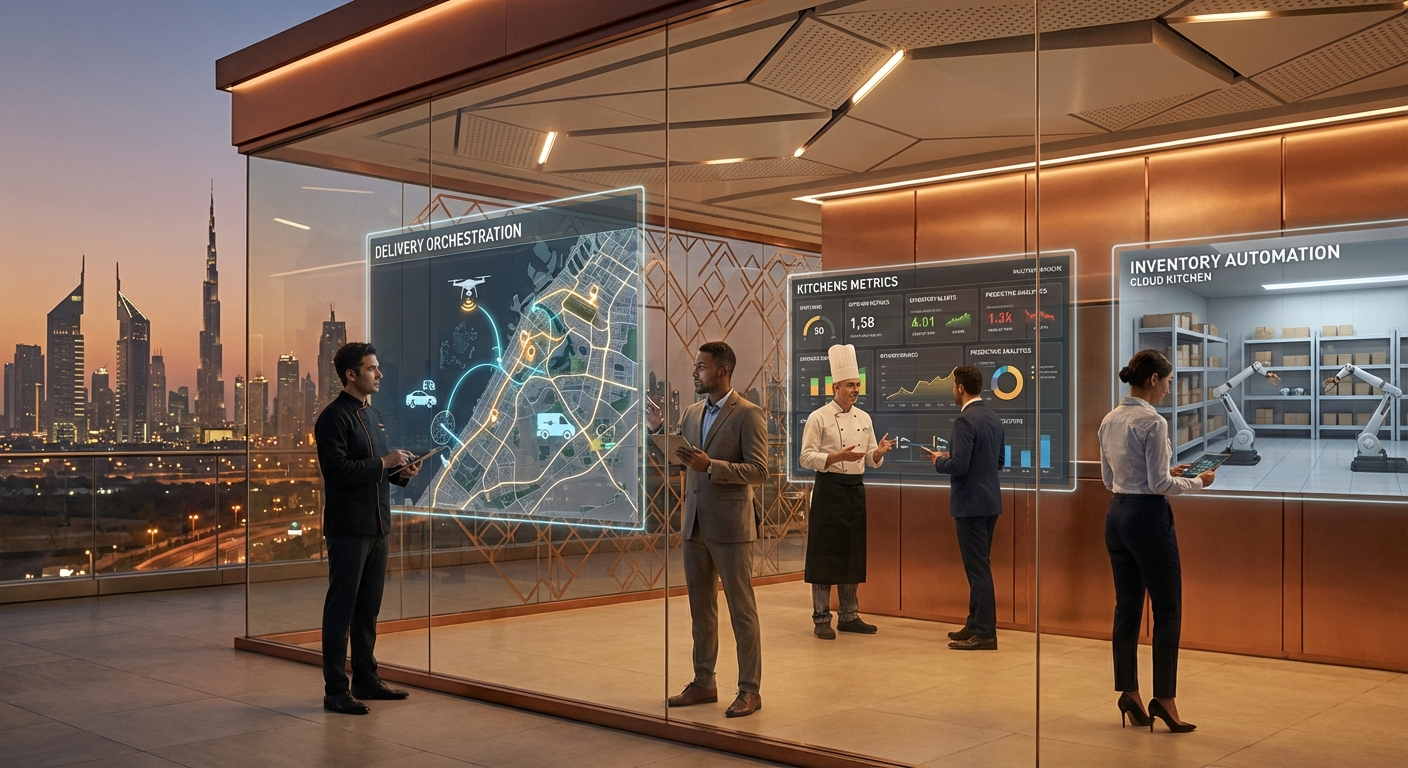
Yes. AI agents can materially improve Dubai food and beverage operations in 2026 by coordinating orders, forecasting demand, automating stock decisions, and reducing delivery delays across cloud kitchens, dine-in brands, and multi-branch restaurant groups. For Dubai operators facing high rent, labor pressure, delivery platform commissions, and volatile ingredient costs in the UAE, the biggest win is not a chatbot. It is an AI team that acts across POS, kitchen, inventory, CRM, and dispatch systems.
Table of Contents
- Why Dubai Food and Beverage Operations Are Ready for AI Agents in 2026
- What AI Agents Actually Do Inside a Dubai Restaurant Group
- Where Dubai Cloud Kitchens Gain the Fastest ROI
- How Inventory Automation Changes Unit Economics in the UAE
- What a Practical AI Team Looks Like for F&B Brands in Dubai
- What It Costs to Deploy AI Agents in Dubai F&B
- Frequently Asked Questions
- Real-World Examples
- About Sinasoft
- Next Steps
Why Dubai Food and Beverage Operations Are Ready for AI Agents in 2026
Dubai food and beverage businesses are operating in one of the most demanding markets in the UAE. Dubai customers expect fast delivery, consistent quality, bilingual service, and peak-hour reliability. At the same time, restaurant groups in Dubai deal with high commercial rents, thin margins, aggregator fees, staff turnover, and highly dynamic demand patterns tied to tourism, Ramadan, weekends, weather, and events across Dubai and Abu Dhabi.
That is exactly why AI agents Dubai operators can deploy in 2026 are becoming strategically useful. A traditional dashboard tells a manager what happened yesterday. An agentic system watches what is happening right now in Dubai stores, predicts what happens next, and triggers decisions automatically. In practice, that means restaurant automation UAE teams can use to rebalance prep volume, cut waste, reallocate riders, launch promotions, and prevent out-of-stock failures before customers in Dubai see them.
For UAE F&B brands, the strongest use case is coordination. One agent monitors incoming orders from Talabat, Deliveroo, Careem, and direct channels. Another checks POS velocity, kitchen ticket times, and rider ETAs. Another forecasts ingredient demand for tomorrow across Dubai branches. Another flags price anomalies from suppliers in the UAE. Instead of one overloaded operations manager trying to hold everything together, AI agents Dubai teams adopt can function like always-on specialists.
What AI Agents Actually Do Inside a Dubai Restaurant Group
The phrase AI agents Dubai can sound vague, so let us make it concrete. In a modern Dubai F&B stack, an agent is a software worker with a defined goal, access to business data, and permission to act within guardrails.
A demand agent can forecast shawarma volume in Dubai Marina, burger demand in JLT, or breakfast traffic in Downtown Dubai using recent sales, day of week, promotions, local events, and weather. A kitchen operations agent can identify when prep stations are running behind in a Dubai cloud kitchen and alert the shift lead before SLA breaches hit delivery apps. A purchasing agent can compare current stock levels, spoilage risk, supplier lead times, and par levels across the UAE, then recommend or auto-create replenishment requests.
A customer recovery agent can detect a late order in Dubai, classify the cause, and trigger a compensation workflow through the CRM. A pricing and promo agent can suggest margin-safe bundles during weak demand windows. A franchise reporting agent can generate end-of-day summaries for UAE executives without midnight CSV exports.
This is why restaurant automation UAE buyers should think in terms of AI teams, not isolated features. A single bot is cute. A coordinated AI team that can monitor, reason, and trigger actions across systems actually changes operations.
Where Dubai Cloud Kitchens Gain the Fastest ROI
Cloud kitchens Dubai operators run are a near-perfect fit for AI agents because the model is already data-heavy and workflow-driven. Orders come in digitally. Performance lives in timestamps. Margin leaks show up fast. If a cloud kitchens Dubai business has three brands, two prep lines, four marketplaces, and shifting lunch-dinner spikes, manual coordination breaks down quickly.
The fastest ROI usually comes from three areas.
First, delivery optimization. AI agents Dubai kitchen operators use can route orders to the best prep sequence, throttle marketplaces during overload, and predict late-delivery risk before the rider arrives. If average delay minutes drop, cancellation rates fall and marketplace ranking often improves.
Second, menu and availability control. Cloud kitchens Dubai teams frequently leave low-stock items live for too long or disable profitable items too early. An availability agent can sync stock-aware menu rules by branch, time, and prep capacity.
Third, labor and prep planning. Dubai F&B demand is not flat. Friday night in Dubai Hills is not the same as Tuesday lunch in Business Bay. AI agents can recommend staffing and batch prep windows that better match actual order curves in Dubai and the wider UAE.
For many Dubai operators, that mix can improve contribution margin faster than any flashy consumer-facing AI project.
How Inventory Automation Changes Unit Economics in the UAE
Inventory is where margins quietly die in food and beverage. Over-ordering raises waste. Under-ordering kills sales. Manual spreadsheet planning across Dubai branches is error-prone, slow, and usually disconnected from real sales velocity.
Inventory automation Dubai restaurant groups deploy in 2026 should do more than count stock. It should connect purchase orders, recipe usage, waste logs, supplier lead times, sales forecasts, and branch-level demand patterns across Dubai and Abu Dhabi. When that system is driven by AI agents, it can move from passive reporting to active control.
Example: a chicken concept operating in Dubai Silicon Oasis, Al Barsha, and Abu Dhabi might see a promotional spike on delivery channels in one zone while dine-in softens in another. An inventory agent can rebalance recommended purchasing, flag transfer opportunities, and warn that marinade stock will breach tomorrow’s par level. A finance agent can translate that into AED impact: expected waste avoided, stockout revenue protected, and gross margin improvement.
For UAE operators, even a 2% to 4% reduction in food waste can matter. On an AED 250,000 monthly ingredient spend, that is AED 5,000 to AED 10,000 back. If a multi-branch Dubai brand spends AED 80,000 to AED 180,000 on a phased AI implementation and captures savings through lower waste, fewer stockouts, and better staffing, the payback window can be surprisingly short.
What a Practical AI Team Looks Like for F&B Brands in Dubai
The right architecture for Dubai food and beverage operations is not one giant model connected to everything. That is sloppy and expensive. The better pattern is a multi-agent setup with narrow roles, clear permissions, and human approval where money or customer experience is on the line.
A practical Dubai deployment usually starts with five agents.
- Demand Forecast Agent for branch, channel, and item-level demand across Dubai and the UAE.
- Inventory Agent for replenishment recommendations, waste alerts, and supplier coordination.
- Kitchen Ops Agent for ticket-time monitoring, prep sequencing, and SLA risk alerts.
- Customer Experience Agent for recovery workflows, complaint classification, and loyalty triggers.
- Executive Reporting Agent for daily summaries, anomaly detection, and branch comparisons in AED.
These agents sit on top of existing systems: POS, delivery platforms, ERP, inventory software, WhatsApp workflows, and BI tools. Most Dubai restaurant groups do not need a full rip-and-replace project. They need orchestration. In 2026, the winning strategy in Dubai is to connect the stack you already have, then automate the operational decisions that waste management time.
What It Costs to Deploy AI Agents in Dubai F&B
Costs depend on scope, branch count, data quality, and integration complexity, but most serious UAE operators should think in phases.
A focused pilot for one Dubai brand or one cloud kitchen can start around AED 35,000 to AED 75,000 for demand forecasting, reporting automation, and basic inventory recommendations. A broader deployment spanning multiple Dubai branches, delivery channels, and approval workflows may run AED 80,000 to AED 180,000. Larger enterprise restaurant groups in Dubai and Abu Dhabi can spend more if they need ERP integration, custom Arabic workflows, franchise analytics, and advanced monitoring.
The mistake is asking only, “What does the AI cost?” The real question is, “What margin leakage are we tolerating today?” If late orders, waste, stockouts, and manual reporting are already costing a Dubai business AED 15,000 to AED 40,000 per month, the ROI case becomes pretty blunt.
The 2026 sources worth watching here include Deliveroo restaurant operations updates, Dubai Chambers digital economy reporting, and UAE Ministry of Economy initiatives. None of those sources alone proves ROI, but together they make one thing obvious: Dubai F&B is moving toward more software-driven operations, not less.
Frequently Asked Questions
Are AI agents better than standard restaurant dashboards?
Yes, because dashboards report the past while AI agents Dubai teams use can monitor live operations and trigger actions. For Dubai food and beverage operations, speed matters.
Can small restaurants in Dubai use AI agents, or is this only for large groups?
Small operators in Dubai can start with one or two high-ROI workflows, especially inventory automation Dubai teams need and daily reporting. You do not need enterprise scale on day one.
Do AI agents replace restaurant managers in the UAE?
No. In the UAE, the practical model is decision support plus selective automation. Managers still approve exceptions, handle people, and own service quality.
What systems do AI agents need to connect with?
Usually POS, delivery apps, inventory software, spreadsheets, CRM, ERP, and sometimes WhatsApp or internal alerting tools. The exact Dubai stack varies by operator.
How quickly can a Dubai cloud kitchen see results?
If the data is clean, cloud kitchens Dubai teams run can often see improvements in reporting speed, stock visibility, and demand planning within weeks. Margin improvements usually follow after that.
Is Arabic support necessary for Dubai F&B AI systems?
Often yes. Dubai and UAE customer operations frequently involve bilingual workflows, Arabic menus, Arabic support requests, and mixed-language data entry.
What is the biggest operational risk when deploying AI agents?
Bad data and weak permissions. If product names, recipes, stock units, or branch mappings are messy, the AI will automate confusion faster.
What should Dubai operators automate first?
Start with demand forecasting, inventory automation Dubai businesses can act on, and end-of-day reporting. Those are usually the cleanest wins.
Real-World Examples
In Dubai, Kitopi remains the obvious reference point for software-led food operations, even if each operator will implement AI differently. The broader lesson is that cloud kitchens Dubai businesses scale best when kitchen workflows, brand performance, and delivery are tightly coordinated.
Talabat and Deliveroo have also trained the Dubai market to expect reliable ETAs, live order visibility, and fast issue resolution. That expectation pressure forces UAE restaurants to get smarter operationally. AI agents are a natural next layer because they help teams respond at machine speed without hiring a human coordinator for every exception.
Across the UAE, restaurant groups using ERP, POS, and delivery integrations already have the raw ingredients for agentic automation. What they usually lack is orchestration logic. That is the gap AI agents Dubai deployments can close in 2026.
About Sinasoft
Sinasoft is a Dubai-based AI automation consultancy specializing in custom AI solutions for UAE businesses. We help companies automate operations, reduce costs, and achieve measurable results through AI implementation tailored to your specific needs.
Next Steps
Ready to automate your business with AI? Let's talk.
📧 Email: [email protected]
🌐 Website: sinasoft.co
➡️ Contact: Book a consultation